Why Chinese Landscape Painting Deserves a Slow Look
Chinese landscape painting is not simply a mountain or river copied onto paper. It is more like nature reorganized by the mind. According to public sources, landscape painting has long valued artistic mood: painters use rocks, clouds, water, and trees to express inner spirit, while viewers enter a world that can be wandered through, lived in, and contemplated. For beginners, appreciating landscape painting does not require memorizing all schools and terms first. You can begin with three entry points: first look at the overall atmosphere, then the textures of rocks and mountains, and finally the arrangement of positions.
First Layer: Artistic Mood—What the Painting Wants You to Feel
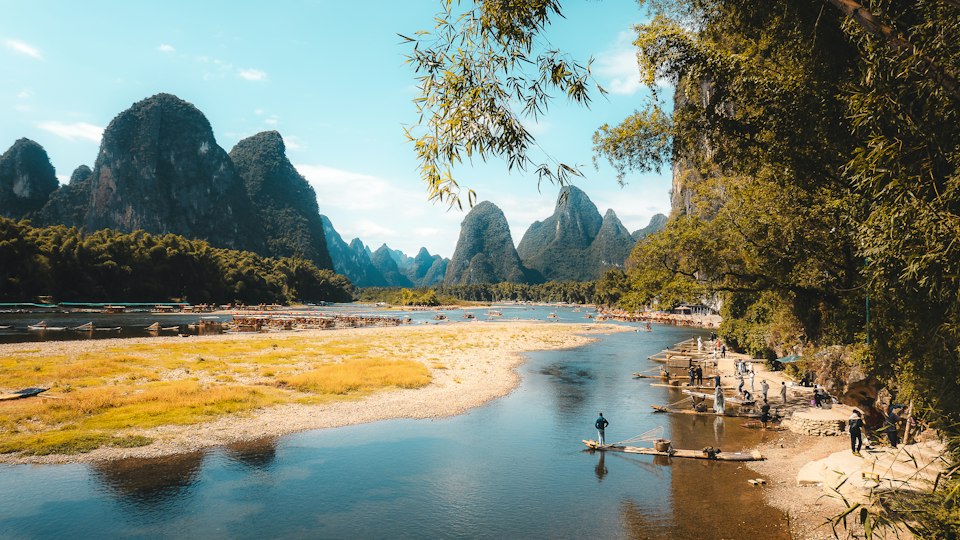
Artistic mood is the easiest part of appreciating Chinese landscape painting to sense, and also the easiest to overlook. It does not simply mean beauty; it is whether the painting creates a feeling, a sense of space, and a spiritual state. When looking at mood, ask yourself: Is the painting cool, grand, quiet, or open and airy? Are distant mountains pale, and nearby trees rich? Does empty space suggest clouds, water, or mist, or simply give the viewer room to breathe?
According to public sources, many traditional theories of painting stress that landscape painting is not merely resemblance; it pursues spirit resonance and artistic interest. Beginners can use a three-step feeling method: first look at tone and ink density, second look at near and far layers, third look for paths that invite entry or places to pause. This keeps appreciation from becoming rote memorization.
Second Layer: Texture Strokes—Why Rocks and Mountains Have Texture
What Are Texture Strokes?
Texture strokes can be understood as brushwork painters use to render the surface quality of rocks, slopes, and cliff walls. Different texture strokes can make a mountain look hard, wet, rounded, steep, or layered. They are both technique and an important clue for identifying landscape painting styles.
How to Recognize Common Texture Strokes
- Hemp-fiber strokes: longer lines like scattered hemp fibers, suitable for earthen hills in Jiangnan or rounded mountains, giving a relaxed, warm feeling.
- Axe-cut strokes: harder brushwork, often producing planes and sharp edges, suitable for rocky mountains, often giving the painting more power.
- Folded-band strokes: lines with turns, like a band folded, common for layered stone slopes or cool, open rocks.
- Raindrop strokes: dots accumulate mountain texture, hazy from afar, dense up close, suitable for wet, full-bodied mountains.
When identifying texture strokes, do not rush to name every stroke. A more practical method is to observe: are the rock surfaces made of long lines, short dots, planes, or turns? How do these brushstrokes shape your judgment of the mountain's hardness, softness, dryness, wetness, and distance?
Third Layer: Composition—How the Painting Arranges Space
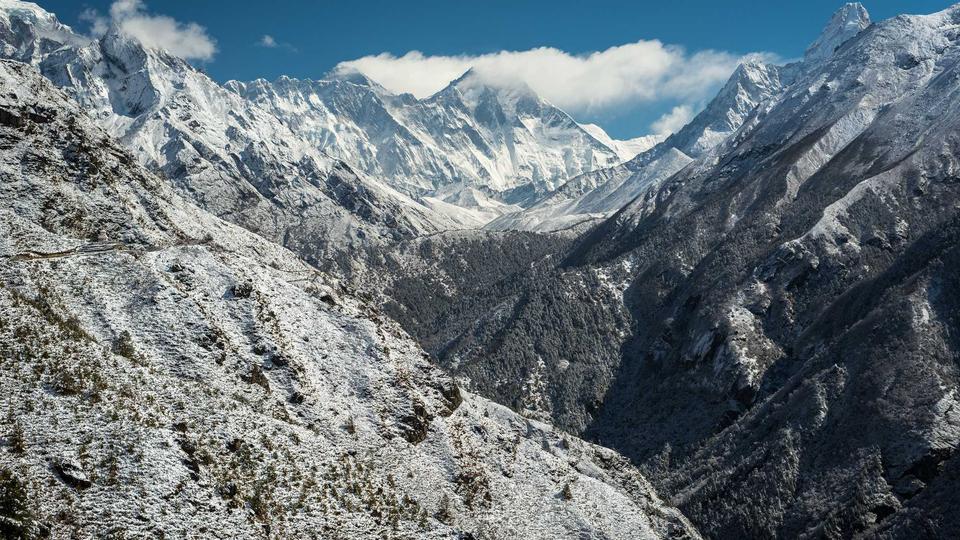
Composition in landscape painting is often called managing positions. It determines how the viewer's eye moves and whether the painting feels open, deep, steep, or peaceful. Beginners can begin to understand space through the three distances: high distance looks at mountains rising upward, deep distance looks at layers pushing inward, level distance looks at horizontal expansion. According to public sources, the three distances are an important traditional formulation of spatial awareness in landscape painting; although they need not be matched mechanically, they help in observing a painting.
Composition Checklist
- Is there a main peak, secondary peaks, or a clear visual center?
- Are foreground, middle ground, and background clear?
- Does empty space suggest clouds, water, or mist, or simply make the painting more breathable?
- Do paths, bridges, houses, and boats guide the eye?
- Do dark and light ink create rhythm rather than being spread evenly?
- Do inscriptions and seals help balance the painting?
Actionable Appreciation Steps: Understand a Landscape Painting Quickly
Steps for Appreciation
- Step 1: Step back and look at the whole: judge the painting's atmosphere—is it grand, clear and quiet, wet, or open and airy?
- Step 2: Look at the rocks: search for texture-stroke traces and decide whether the mountain forms are rounded, hard, layered, or hazy.
- Step 3: Observe the space: identify foreground, middle ground, and background, and notice how empty space becomes clouds and water.
- Step 4: Find details: how houses, bridges, boats, figures, and inscriptions help make the painting a place one can wander through and live in.
- Step 5: Summarize: write one sentence about how the painting makes you feel, for example: distant mountains fade, nearby rocks have strength, and the empty spaces feel like wind.
Common Beginner Misjudgments
Many people first ask whether a landscape painting looks real. This is not the only standard. The mountains in landscape painting may come from direct observation, or from memory, imagination, and ink-brush tradition. A more worthwhile question is: how do painters use density, sparseness, dryness, wetness, solid and empty areas to turn nature into a state of mind that can be felt?
Another misconception is treating texture strokes as fixed formulas. A single painting may combine several texture strokes, or they may appear different because of paper, ink, brush energy, and period style. When appreciating, first feel the texture, then try to name it; this is easier than memorizing terms first.
References
Disclaimer: This article is compiled from publicly available online sources for educational purposes only and does not represent the official position of Guanshan Academy. If you believe your rights have been infringed, please contact us for removal.
Contact: chenxj.g@gmail.com