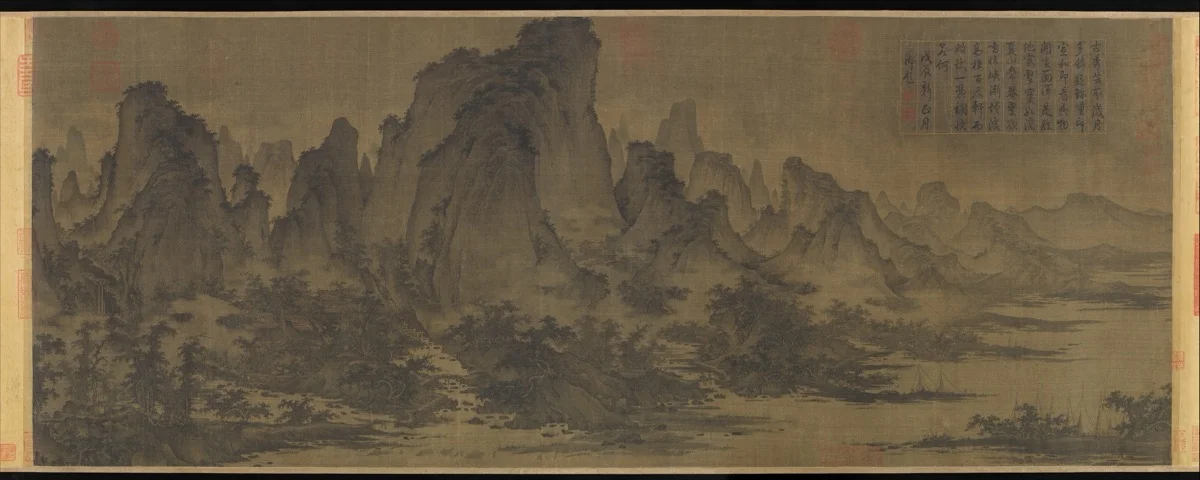
1. Understanding the Character of Northern Song Landscape Painting Through a Single Main Peak
When discussing Northern Song landscape painting, Fan Kuan’s Travelers among Streams and Mountains is often mentioned. According to public sources, this work is widely regarded as Fan Kuan’s representative painting and an important benchmark of the mature phase of Northern Song landscape painting. It is called a “pinnacle” not merely because of its age, but because it elevated landscape painting from decorative appeal to an order endowed with spiritual weight.
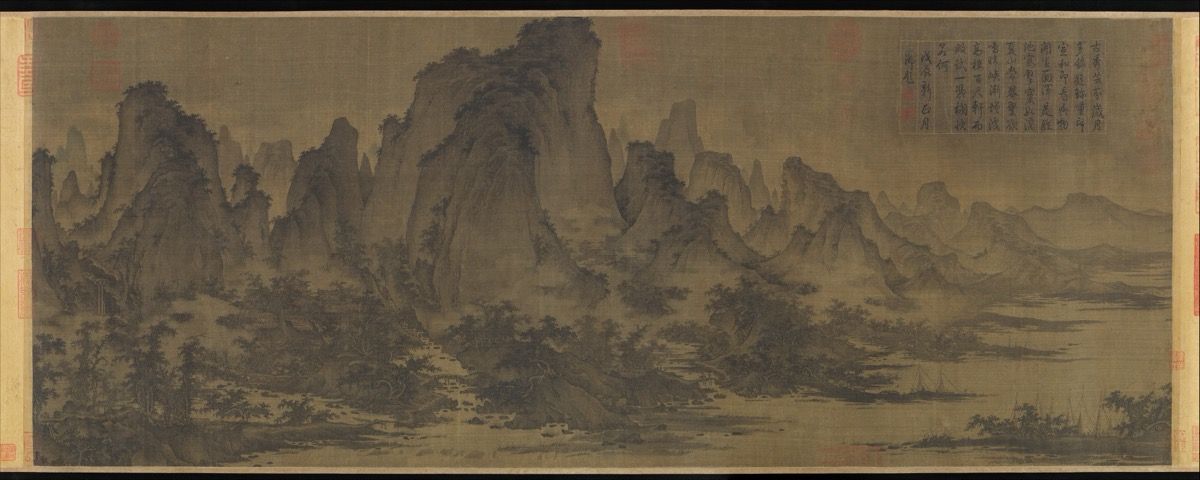
At first glance, the strongest impression is one of stability. The main peak stands at the center, massive and solemn. Standing before the painting, viewers feel as if facing an enormous stone wall. The mountain is not a casually arranged scene, but a presence that seems to preside over everything. Within it, human figures appear small, yet not diminished. This structure—grand without emptiness, heavy without oppression—embodies the dignified spirit characteristic of Northern Song landscape painting.
2. Composition: A Towering Peak and Minute Travelers
The composition of Travelers among Streams and Mountains is not complex, yet it is richly layered. In the foreground are slopes, rocks, and trees; in the middle ground, a path with travelers; in the distance, the main peak rises high, while a waterfall descends like a slender thread. The painting does not rely on clever or unusual variations; instead, its stable, central-axis layout creates a sense of solemnity.
1. Great Mountain and Small Figures
The most thought-provoking aspect of the painting is its sense of scale. The mountain is immense, while the traveling party is tiny. If one looks only at details, it is easy to overlook the figures along the mountain path; once found, they reveal a subtle contrast: nature is vast, human affairs are minute. This treatment does not diminish humanity; rather, it returns people to their place between heaven and earth. The travelers hurry along, pack horses move forward, but the mountain remains silent and still. Movement and stillness, smallness and greatness set off one another, giving the painting both narrative and philosophical depth.
2. Waterfall and Mountain Path
According to public sources, the waterfall in the painting plunges straight down from a height, as if cutting a streak of light through the massive mountain. The path winds inward from the foreground, guiding the viewer’s eye deeper into the scene. The waterfall creates vertical momentum, while the path creates horizontal movement; together, they give the still mountain a sense of breath.
3. Brush and Ink: Structural Strength in Raindrop Texture Strokes
If composition determines the painting’s momentum, brush and ink determine its texture. Fan Kuan’s brushwork does not win through lightness or elegance, but through depth and weight. According to public sources, later viewers often summarize his treatment of rocks and mountains with the term “raindrop texture strokes”: short, dense, and forceful, like raindrops striking rock, or chisel marks left on stone.
- Texture strokes: Short, dense touches are layered one upon another, giving the rocks and mountains a solid, sculptural mass.
- Ink tones: Repeated washes of dark and light ink avoid both frivolity and rigidity.
- Trees: The trees in the foreground have upright trunks and fine, dense foliage, echoing the heaviness of the rocks and mountains.
This brushwork does not aim for superficial beauty; it aims to reward prolonged looking. At first, it may seem dark, dense, and heavy, but closer inspection reveals subtle layers. Like reading a book: the first reading grasps the general meaning, while later readings reveal its structure. When Fan Kuan painted mountains, he valued structural strength as in writing an essay: every stroke and every ink tone must stand firm, without emptiness or affectation.
4. Mood: Not Mere Scenery, but a State of Mind
The moving power of Travelers among Streams and Mountains also lies in the fact that it creates not merely a landscape, but a state of mind in which one can dwell, walk, wander, and reflect. Northern Song landscape painting often emphasized the “mind of forests and streams,” the spiritual longing of scholar-officials for mountains and woods amid worldly life. This painting has neither the liveliness of a literati gathering nor the fantasy of immortal mountains and pavilions. It offers only a path, a group of travelers, a mountain, and a waterfall, yet it is enough to quiet the mind.
According to public sources, Fan Kuan valued direct observation of nature and stressed learning from real mountains and waters. The painting’s grandeur is therefore not born of empty imagination, but from long contemplation of the atmosphere of mountains and rivers. It does not turn landscape into a postcard, but into an ideal of character: steady, expansive, unflattering to fashion, and free of clever tricks.
5. Signature and Details: Authorial Awareness Hidden Within the Painting
According to public sources, the artist’s signature in Travelers among Streams and Mountains is not conspicuous; researchers often note that it is hidden among the trees in the lower right corner of the painting. Unlike the large, prominent inscriptions of later periods, this discreet signature does not compete with the main image. Yet it reminds viewers that the work possesses a clear sense of authorship. The painter is not an anonymous craftsman, but an artist establishing himself through personal style.
This also reminds us that appreciating an old painting is not only a matter of asking whether it looks “lifelike,” but also of examining how it is organized. How the mountain stands, how the water flows, how the travelers move, how the trees grow—all are the painter’s arrangements. Fan Kuan’s mastery lies precisely in organizing complex nature into a clear order.
6. Practical Steps: Five Steps for Appreciating Travelers among Streams and Mountains
- Step 1: View the overall momentum from a distance. Do not rush to search for details. Stand before the whole composition and feel both the pressure and the stability created by the main peak.
- Step 2: Find the central axis. Observe whether the main peak, waterfall, and path form a visual center, and notice how the painting maintains balance.
- Step 3: Look for the travelers. Examine the area between the foreground and middle ground closely, find the tiny figures and pack horses, and understand the theme of “traveling.”
- Step 4: Study the brush and ink up close. Focus on the short texture strokes on the rocks and mountains, and compare the ink tones in the light and dark areas.
- Step 5: Return to the mood. Ask yourself: does the painting give you a sense of bustle or stillness? Of clever novelty or weighty grandeur?
7. Viewing Checklist
- Have you noticed that the main peak occupies the center of the picture and creates a sense of solemnity?
- Have you seen the movement introduced by the waterfall and the mountain path?
- Have you found the traveling figures and understood how their smallness sets off the vastness of the mountain?
- Can you identify the short, dense texture strokes and feel their tactile quality?
- Have you noticed how trees, slopes, rocks, and mist help transition between spatial layers?
- Can you summarize the overall atmosphere with words such as “majestic,” “weighty,” “still,” and “solemn”?
- Are you willing to look again, comparing the relationship between details and the whole?
8. Further Suggestions for Readers
If you appreciate Travelers among Streams and Mountains from the perspective of reading, you can treat it as a piece of Northern Song classical prose. The opening establishes its thesis with the main peak; the middle develops through the waterfall and the path; the conclusion gathers itself in the traveling party. It does not rely on ornate language, but on rigorous structure and a noble spirit. For beginners, there is no need to master a large number of technical terms first; simply grasp three key terms: composition, brush and ink, and mood.
For further study, compare Fan Kuan with other landscape traditions of his time. Some painters favored cold forests and level-distance views, while others excelled in towering peaks and high cliffs. Through comparison, Fan Kuan’s characteristics become easier to see: he avoids cleverness and frivolity, establishing his style through weight and depth. The phrase “the pinnacle of Northern Song landscape painting” is not empty praise; it is embodied in this visual order, which can be seen, studied, and savored again and again.
References
Disclaimer: This article is compiled from publicly available online sources for educational purposes only and does not represent the official position of Guanshan Academy. If you believe your rights have been infringed, please contact us for removal.
Contact: chenxj.g@gmail.com